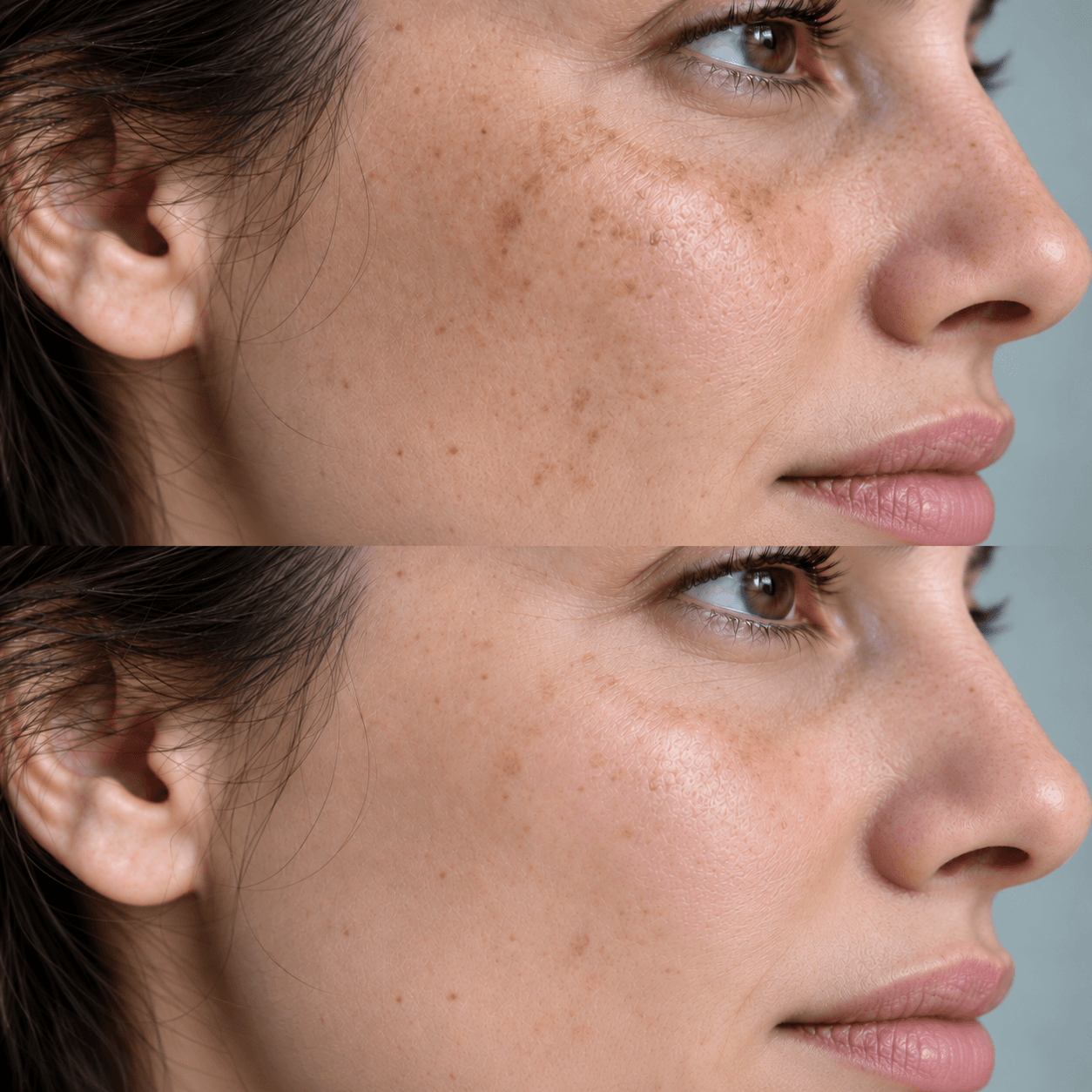
Why Pigmentation Spots Appear
Hyperpigmentation occurs when melanin production in the skin becomes uneven or excessive in certain areas. The main causes are: UV exposure (sun, tanning beds) — the most common trigger Hormonal changes — especially in melasma, often linked to pregnancy, birth control, or menopause Post-inflammatory hyperpigmentation — marks left after acne, injury, or a procedure Age-related changes — lentigines ("age spots") Genetic predisposition Melasma is a particularly stubborn condition — its prevalence reaches up to 30% among Asian women of childbearing age, and its pathogenesis involves not just excess melanin synthesis but also vascular proliferation, inflammation, and skin barrier damage.
What Is a Skin Booster and How Does It Affect Pigmentation?
A skin booster is a series of micro-injections of stabilized hyaluronic acid placed into the superficial layers of the skin — not for contouring or volume, but purely for improving skin quality. A skin booster: Deeply hydrates the dermis Improves skin elasticity and firmness Evens out texture and tone Creates a healthier environment in which the skin's own repair processes work more effectively
What Is PRP (Plasma Therapy) and Its Mechanism
PRP (Platelet-Rich Plasma) is prepared from the patient's own blood through centrifugation. Growth factors released from platelets: Activate fibroblasts and boost collagen synthesis Increase the skin's own natural hyaluronic acid production Reduce inflammation — directly relevant to hyperpigmentation Support vascular and epidermal repair processes
What International Research Says About PRP + Skin Booster for Pigmentation
This isn't just marketing language — several recent clinical trials have directly studied the combined approach:
1. PRP + Hyaluronic Acid Mesotherapy for Melasma (2026)
A study of 57 patients divided participants into three groups: PRP+HA, PRP alone, and HA alone. The effective rate of chloasma treatment in the PRP group and the PRP+HA group was more than 50% at 4 weeks after treatment, and the improvement of the above indexes in the PRP+HA group was better than those in the single treatment group. Pigment number reduction rates were 14.73% in the PRP+HA group, 10.79% in the PRP-only group, and 5.76% in the HA-only group, with a statistically significant difference between the PRP+HA group and the HA group. Patient satisfaction was also higher in the PRP+HA group compared to the HA-only group. The researchers concluded that PRP mesotherapy alone or combined with HA can effectively treat chloasma, with the combined treatment producing a better effect and being worthy of clinical adoption
2. PRP + Tranexamic Acid for Melasma
A retrospective analysis of 80 melasma patients found the overall efficacy of PRP combined with oral tranexamic acid reached 90.48%, compared to 73.68% in the group receiving oral tranexamic acid alone
3. Microneedle Fractional Radiofrequency + PRP (Split-Face Trial)
A prospective, randomized, split-face clinical trial conducted at the Dermatology Department of the First Affiliated Hospital of Chongqing Medical University compared microneedle fractional radiofrequency plus PRP against radiofrequency alone in patients with stable facial melasma — a particularly reliable study design since it compares both sides of the same patient's face.
Why does the combination outperform monotherapy?
Mechanistically, platelet growth factors amplify the effect of the hyaluronic acid booster — the result isn't just hydration, but deeper cellular repair, collagen stimulation, and reduced inflammation, which directly lowers excess melanin production.
What to Expect From the Treatment Protocol
Based on established international protocols, combined PRP + skin booster treatment typically involves: Number of sessions: 3–4 sessions, spaced 2–4 weeks apart Session length: approximately 45–60 minutes Downtime: mild swelling or bruising for up to 2–3 days First visible results: within 4 weeks; full effect over several months
Contraindications
This treatment is not suitable if you have: Pregnancy or breastfeeding Blood clotting disorders or are taking blood-thinning medication Active infection or inflammation in the treatment area Autoimmune or oncological conditions Low platelet count
VELE — Aesthetic Medicine Clinic in Tbilisi, Saburtalo
VELE is a medical aesthetics clinic in Tbilisi, located in the Saburtalo district (4 Otar Oniashvili St.), where every procedure is planned and performed by a certified doctor.
VELE's Mission and Approach
According to the clinic, VELE was founded on the belief that beauty looks its best when it's natural — and safe. The clinic's core principles are: Diagnosis first, procedure second — nothing is recommended before a proper skin assessment Natural results — the goal is a rested, healthy appearance that preserves the patient's natural facial character Safety and certified products — only original, certified products and single-use sterile materials Honest advice — including, when appropriate, recommending that a patient wait rather than proceed VELE's team includes licensed dermatologists, cosmetologists, and trichologists who regularly update their training through international courses.
Pigmentation-Related Procedures at VELE
PRP Therapy + Skin Booster Combined regenerative protocol — collagen synthesis, tone, texture correction From 599 GEL 60 min Chemical Peel Pigmentation, post-acne marks, controlled skin renewal From 169 GEL 45–60 min Skin Booster Deep hydration, tone and texture improvement From 349 GEL 30–45 min PRP Therapy Skin regeneration, also used for scalp support From 249 GEL Prices are approximate — an exact plan and cost are determined during a free consultation.
Why Choose VELE for This Treatment
Every visit begins with a doctor's consultation and skin diagnostics The team includes cosmetology physicians with pharmaceutical backgrounds (e.g., Dr. Sofio Lominashvili, who holds a master's degree in cosmetology science with a pharmaceutical-toxicological foundation) Average rating — 4.9★ Located in Saburtalo, near Gagarini Square Opening hours: Monday–Saturday, 10:00–22:00
Frequently Asked Questions (FAQ)
How long does it take to see results from PRP + skin booster for pigmentation? Initial changes are visible within 3–4 weeks, with full, stable results appearing after completing a course of 3–4 sessions, typically within 2–3 months.
How many sessions are needed?
Based on international research and clinical practice, 3–4 sessions spaced 2–4 weeks apart are typically recommended.
How many sessions are needed?
Based on international research and clinical practice, 3–4 sessions spaced 2–4 weeks apart are typically recommended. Can PRP + skin booster treat melasma, not just sun spots? Yes — a 2025 study directly confirmed the effectiveness of combined treatment for facial chloasma (a type of melasma), though melasma often requires an additional, individually tailored approach (e.g., topical agents, strict sun protection). Is the procedure safe? Across the reviewed clinical trials, no serious adverse effects were reported in any treatment group — only mild, temporary swelling or bruising. How much does the procedure cost in Tbilisi? At VELE clinic, a combined PRP + skin booster session starts from 599 GEL, while a single chemical peel starts from 169 GEL. Exact pricing depends on the individual treatment plan.